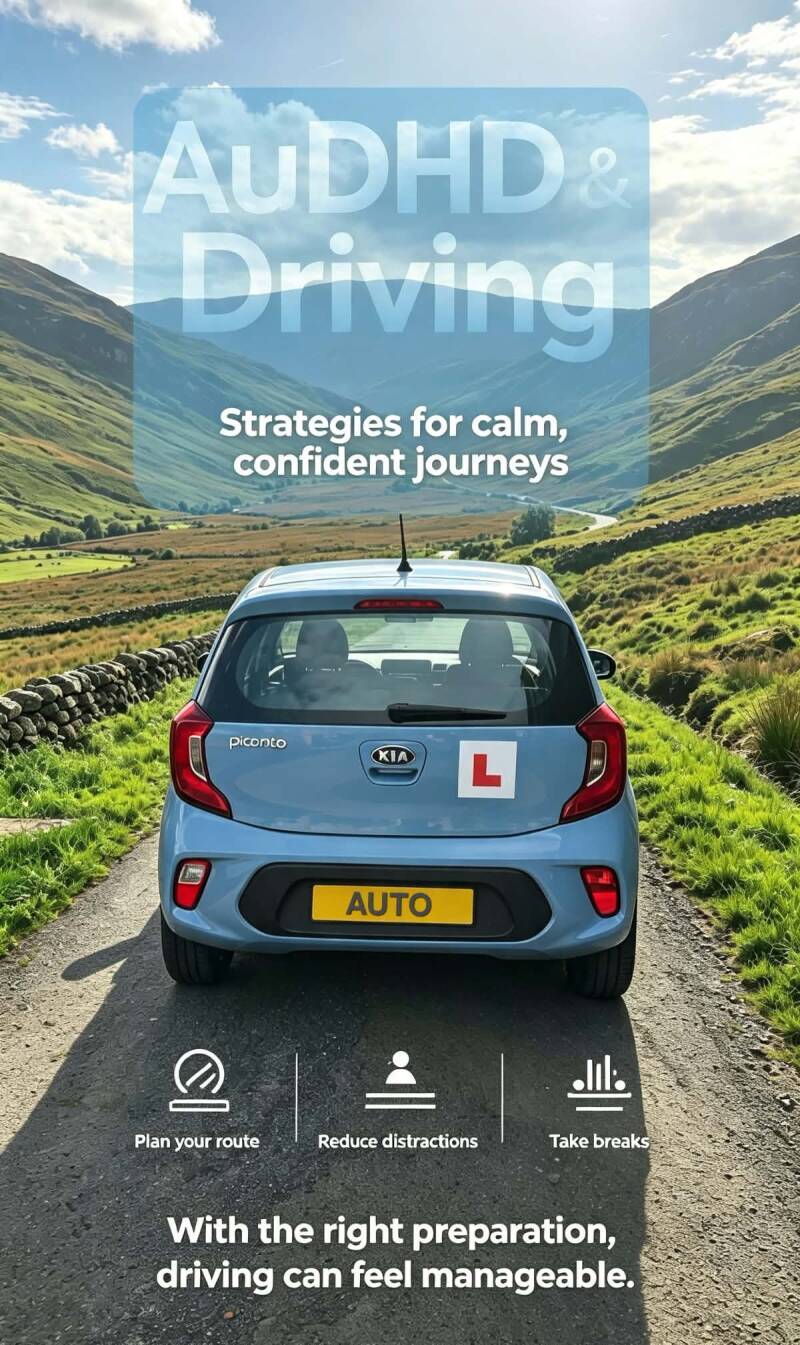
Learning to drive with AuDHD (co-occurring Autism and ADHD) involves navigating a unique mix of cognitive strengths and distinct friction points. Because Autism and ADHD present contrasting processing styles, young AuDHD drivers often experience a pull between rigid rule-following and erratic focus.
Core Challenges Facing AuDHD Learners
1. Executive Function & Task-Switching
◦ Driving requires processing visual, auditory, and spatial input all at once (checking mirrors, managing foot pedals, monitoring speed, and predicting pedestrian movement).
◦ AuDHD learners often struggle with working memory and rapid context-switching. Shifting attention quickly from a road sign back to the car directly ahead can feel draining.
.
1. Sensory & Emotional Overload
◦ High-intensity environments—bright headlights, sudden sirens, heavy rain, or noisy cabin chatter—can trigger sensory overload.
◦ When overstimulated, processing speed drops. This increases the risk of "freezing" or feeling intense panic at chaotic intersections.
2. Inattention vs. Hyperfocus (The ADHD Half)
◦ On routine or quiet roads, the ADHD trait of under-arousal can lead to daydreaming or missing subtle environmental changes.
◦ Conversely, intense hyperfocus might cause a driver to lock onto one hazard (e.g., a cyclist ahead) while missing a light changing color in their peripheral vision.
3. Literal Rule-Following vs. Unpredictable Traffic (The Autistic Half)
◦ Autistic learners tend to learn driving rules precisely. However, real-world driving relies on "unwritten rules"—interpreting eye contact from pedestrians or handling drivers who cut in illegally. Unpredictable behavior from other road users can cause frustration or distress.
4. Spatial Awareness & Motor Coordination
◦ Co-occurring difficulties with proprioception (knowing where your body and car are in space) can make parking, staying centered in a lane, and smoothly coordinating clutch/brake pedals take longer to master.
Strengths AuDHD Learners Bring to the Road
• High Rule Compliance: Autistic traits naturally foster strict adherence to speed limits, traffic signals, and safety guidelines.
• Hyper-Awareness of Detail: When engaged, neurodivergent drivers often spot details that others miss, such as obscure road signage or subtle changes in hazard patterns ahead.
• Systematic Learning: AuDHD individuals often excel when taught through clear, logical sequences and structured step-by-step frameworks.
Effective Strategies for AuDHD Drivers
| Strategy | Why It Helps |
|---|---|
| Learn in an Automatic Car | Removes manual gear shifts and clutch control, freeing up cognitive bandwidth for hazard perception. |
| Neurodivergent-Friendly Instructor | Look for instructors experienced with ASD/ADHD who give clear, unambiguous instructions without relying on social metaphors. |
| Sensory Management | Wear polarized sunglasses to reduce glare, turn off radio noise during practice, and maintain comfortable cabin temperatures. |
| Route Pre-Planning | Preview complex intersections on Google Maps or Street View before driving to minimize surprise and anxiety. |
| Shorter, Frequent Lessons | 60-90 minute sessions prevent executive burnout and fatigue compared to standard two-hour blocks. |